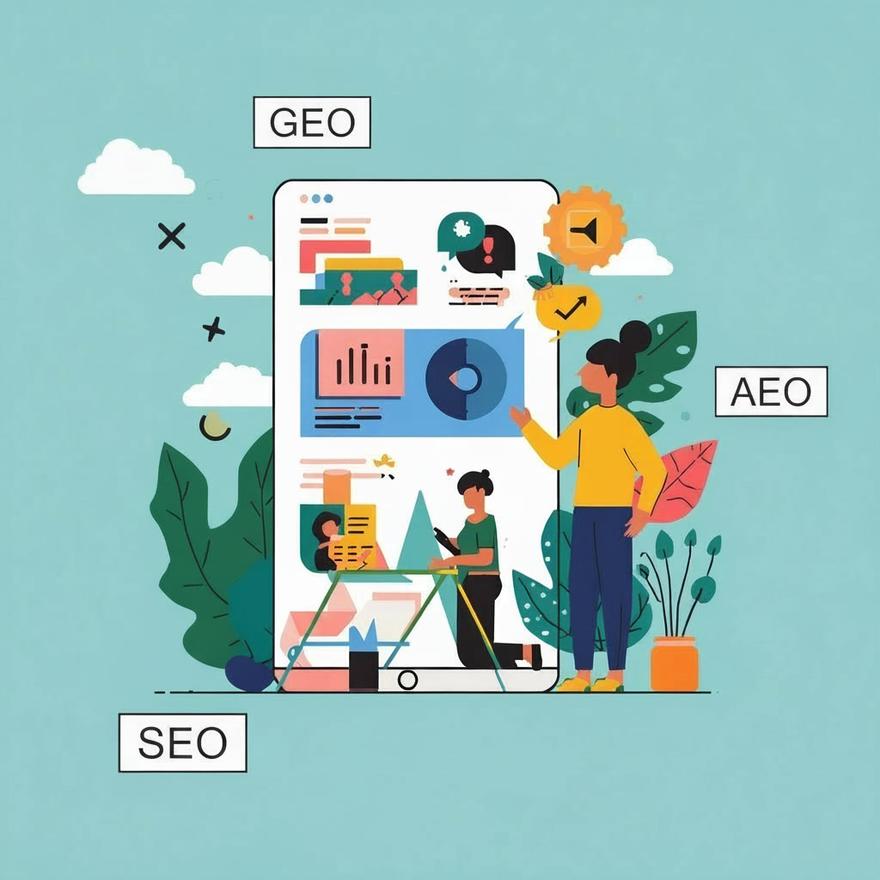
Why We Need to Change How We Develop Content: The Shift from Ranking (SEO) to Retrieval (GEO/AEO/AIO)
With the rise of AIOs in Google and more users moving to LLMs to get information, the new reality means that search engines and LLMs are prioritizing answers over keywords, pulling concise, trustworthy information directly from online content. Therefore, the writing must be optimized not just for ranking, but for retrieval and citation.
Traditional SEO focused on keyword density, backlinks, and on-page optimization. But in the age of generative AI, success means creating content that can be quoted, parsed, and trusted by AI search and LLMs.
Content creators must shift from writing primarily for search engine rankings to crafting articles that are well structured, complete, and include semantically rich “content chunks” that directly answer specific queries and fuel AI-generated responses.
By incorporating the following content authoring standards into every new article and all updates, we can optimize website content to become a consistent source of authoritative content for both people and machines.
I. Write for Retrieval: Get to the Gist of Things
Inherent in these guidelines is the need to explicitly state the “gist” of things throughout each article. This means all topics and subtopics have either:
- a clear and succinctly written answer to a question or
- a thesis statement that explains the gist of a topic or subtopic.
When AI tools respond to a query, they’re looking for content that immediately answers the question or states the entire scope of the topic in a clear and direct.
Take a common query like: "What is a secured loan?"
An AI-friendly response starts like this: “A secured loan is a loan that requires you to use an asset as collateral.” This direct approach ensures the system recognizes and extracts the answer cleanly.
This is true whether the query and response are at the H1, H2, or H3 level.
Keeping the response to ~160 characters allows for the succinct answer to fit neatly into a SERP feature.
II. Use Natural Language for all H1s, H2s, and H3s
Both LLMs and search engines prioritize content that is written in a way that feels conversational and natural. When you use natural language in your headings, you make it easier for AI models to understand the intent behind the content and pull relevant snippets.
- AI Query Matching: AI tools, like Perplexity and Google’s AIOs, are more likely to pull natural-sounding headings because they align with how users phrase their questions.
- Search Engine Optimization: Google’s algorithm is designed to recognize headings in natural language, and using this style helps search engines understand the context and relevance of your content more effectively.
This requires a shift to using long-tail keywords and queries more frequently within the headings and subheadings. Keyword research should focus on finding the best long-tail keywords that cover a topic completely and using queries that would naturally be asked by users (i.e. don’t use questions as subheadings that people don’t really ask).
III. Structure Content for AI Chunking
LLMs and most search engines now extract passages or chunks that best match the query intent. This means that subtopics of any given article could be retrieved as the best match for a query, so we need to treat all sections of an article as modular chunks of information that can stand on their own.
Likewise, Google search will often ignore the traditional “marketing speak” of the page meta description and pull the best answer for any (topic-related) query from anywhere within the article into the SERP feature.
To optimize for this new reality, each section of the article should function as a standalone unit or “content chunk”:
- The introduction of all articles should include an immediate and succinct answer to the H1 heading query [ex. What is a Personal Loan?] or a thesis statement that explains the gist of the H1 heading topic [ex. Debt Snowball Method vs. Avalanche Method]. Ideally, this should be done within ~160 characters so the most relevant part can show in SERP features.
- All H2 or H3 subheadings should cover one core idea, whether it’s posed as a question or not.
- The text that follows every H2 or H3 should immediately and succinctly answer the question or state the entire thesis of the heading or subheading (ideally, within ~160 characters).
- These content chunks should be understandable without needing to reference or depend on any other section on the page.
Topic & Query Chunk Examples
H1 Topic & Thesis
Applying for a Personal Loan Online vs. In Person
Online banks may provide greater access and ease for borrowers who are pressed for time, live in remote areas, or do not want to visit a branch. Your local bank, though, may offer more financial products and personal help [222 characters]
H2 Query and Answer
Why is financial stability important?
Being financially stable is important because it can impact your financial health. It can also affect your mental health. Studies show that financial worries can lead to stress anxiety. [186 characters]
Think of your content like modular building blocks: each one should be self-contained and valuable on its own.

IV. Format for Semantic Clarity
HTML structure plays a significant role in how AI systems interpret and retrieve content.
Use H2 headings for major sections and H3 subheadings for supporting points. This helps AI models segment your content semantically and understand the relationship between ideas.
Example:
<h2> Why is financial stability important? </h2>
<p> Being financially stable is important because it can impact your financial health. It can also affect your mental health. Studies show that financial worries can lead to stress anxiety. </p>
This structured approach allows AI search engines and LLMs to “see” each section as a discrete snippet, ready for extraction and citation.
V. Write Complete, Context-Rich Answers
Surface-level content doesn’t cut it anymore. AI systems favor passages that are complete, nuanced, and supported by evidence.
After leading with a concise answer, expand with relevant context, data, or examples. For instance, the content that follows the example in the last section fully covers the topic:
When you feel financially stable, you don’t worry about paying your bills and handling your debts. Financial stability means you:
- Can pay your loans and credit card bills without giving up the fun things you enjoy.
- Don’t worry that one unexpected expense could ruin your finances.
- Might take career risks because you have a safety net in case a job change doesn’t go as planned.
- Can afford “wants” like vacations or dining out without taking on unmanageable debt.
But many people don’t live this way. According to research from the Federal Reserve, 31% of Americans felt worse off financially in 2023 than they did in 2022. And 37% say they would struggle to cover a $400 emergency expense.
This not only answers the initial query immediately but goes on to show depth and authority on the topic, two traits that AI systems are trained to prioritize.
VI. Use Up-to-Date and Relevant Statistics and Sources to Build Authority
By citing relevant and respected sources to support your article topics, you build your authority as a trusted source of personal finance information. Whether the citations come from external sources or in-house research, using more of this type of supporting evidence can boost the chances of retrieval.
Find ways to incorporate in-house research into existing articles and consider creating a new article that cites the in-house research to help boost the reach beyond any PR campaigns.
VII. Leverage Query Fan-Out to Build Topical Authority
AI search uses a process known as query fan-out to break down complex queries into smaller subqueries. For example, “what is credit history” might be decomposed into:
- “Why is credit history important?”
- “Where do you find your credit history?”
- “How long does it take to build credit history?”
To be retrieved, your content needs to demonstrate both topical depth and breadth by offering detailed answers across related subtopics.
Building topical authority requires comprehensively covering the subject matter so that AI search engines see you as a trusted source. Targeting keywords just doesn’t work anymore.
VII. Implement a Topic Cluster Strategy for AI-Friendly Architecture
Another way to show topical authority at a more macro level is to organize your content using a pillar-cluster model, which improves both human navigation and AI comprehension.
- Pillar pages offer a high-level overview of a broad topic (e.g., “10 Things Your Need to Know About Personal Loans”).
- Cluster pages dig into specific facets of the broad topic (e.g., “What is an installment loan,” “APR vs interest rate,” “What is an unsecured loan”).
The pillar page is essentially a “complete” guide to the broad topic of the cluster and links out to all the supporting pages that cover the related topics more directly. These internal links create the semantic relationships that AI search and LLMs use to understand your site’s structure and subject-matter authority.

A pillar page with topic clusters
IX. Expand the Retrieval Surface Area
To increase your chances of being cited across various queries, you need to expand your content’s retrieval surface area within your topic clusters.
Two ways to do is is by:
- Covering different angles of a topic (e.g., beginner, advanced, tactical, strategic)
- Writing content for different intents (informational, how-to, comparison)
You can see how this approach lends itself to creating content for specific personas who have varying levels of knowledge and needs. By parsing out content based on types of readers with specific needs (ages and stages), you can ensure your content covers more specific and relevant topics.
Another way to expand the retrieval area is by including alternative phrasings of key questions. For instance, instead of just writing “How to stop spending money”, include variations like:
"How to stop overspending”
“Avoid overspending”
“Better spending habits”
Each variation increases the number of queries your content can be cited for.
Conclusion: Future-Proofing Your Content Strategy
LLMs and AI search is reshaping how information is discovered, consumed, and credited. As content creators, the path forward is clear: write less for rankings, more for retrieval.
This means:
- Answering questions clearly and directly
- Structuring content into semantically clean, standalone sections
- Covering topics thoroughly with context and authority
- Creating a content ecosystem that signals expertise across related areas
By adapting your strategy now, you position your content to be found and used—by AI search engines, LLMs, and human audiences alike.