Let’s take a look at what all the authoring standards I spelled out in my last blog post look like in practice. These standards are designed to get teams optimizing for GEO, AEO, and AIO quickly, without touching the underlying information architecture (which matters too but requires more of a lift). Here I’ll review a live Your Money or Your Life (YMYL) blog article to see how well it adheres to those standards and how they can help boost the content citations with AI search engines and LLMs.
To Chunk or Not to Chunk Content
But first, I want to address some push back I’ve seen lately on the idea of content chunking to gain better AI search visibility for brands and content publishers. Plenty of GEO checklists and articles make the same claim: on page content chunking provides ready-made content snippets or answers for generative search engines and Google AIOs.
The argument against is simple: writing for machines is a bad idea. You can see that sentiment here from a LinkedIn user and here, straight from the mouth of Danny Sullivan at Google.
As a content strategist who has long solved problems for both humans and machines in my day-to-day work, I agree that writing human-facing web content strictly for machines is, obviously, a bad idea.
But I also see where that sentiment comes from: a world where Google reigned supreme by owning a search market that operated behind a veil of algorithm secrecy and where SEO shops could brute force their way to the top of the SERP page by gaming the Google ranking algorithm.
Thankfully, that world is gone.
While many LLMs still use Google or Bing search engines to find answers, the requirements for visibility on the LLMs are different and still emerging. Content chunking works when strong writers cover topics completely and succinctly, structuring paragraphs as modular components that can stand on their own but still make sense as being part of the whole.
Top of Page SEO Still Matters for Context Building
What appears at the top of any webpage or blog post is important for how both the machines and humans understand what the page is about. Structured URLs, categories, and breadcrumbs are all a part of the underlying information architecture (IA) that is equally, if not more, important than the on-page elements such as a logical topic hierarchy (represented by H1s, H2s and H3s) and other structured data. They all give context to machines and humans alike, while also keeping humans grounded in where they are within the architecture of the site.

How Your Site Structure and Taxonomy Can Work Against Your On-page Efforts
Before covering on-page optimizations, I want to take a moment to share how the underlying structure of the website (or the IA) can work against your on-page efforts. In the example above, the URL structure is not completely aligned with the blog category and breadcrumb that shows at the top. The URL has “consolidate-debt” as the category, while both the on-page category and breadcrumb add the concept of reducing debt.
While consolidation and reducing debt are related concepts, they are different and imply different intents. Consolidation is a financial tool where you restructure existing debt into a single loan, typically to simplify payments or lower interest. The debt doesn't go away; you're just reorganizing it. Reducing debt implies a different goal: paying it down, eliminating it, changing your net financial position. A user searching "how to consolidate debt" and a user searching "how to reduce debt" are at different points in their financial thinking and looking for different answers.
Having both Consolidate and Reduce Debt as a single category on the page changes the “gist” of what the article is about. And more than that, it’s combining two equally strong concepts, when covering both concepts separately and completely would build far more authority through the breadth and depth of the topics on the site.
Because the table of contents and article thesis clearly indicate that the article is focused solely on how and when to consolidate debt, you can see how including the concept of reducing debt on the page is more confusing than helpful and sends mixed messages to the machines. Likewise, the "reduce debt" framing in the breadcrumb is a promise the page doesn't keep. That's the real IA problem. Machines following that breadcrumb signal to evaluate page relevance will find a mismatch.
In this way, the underlying information architecture confuses the machines in ways that human readers might forgive. Reworking the category taxonomy to focus on one high level concept at a time is needed. And, as a rule, breadcrumbs need to show the real path of the underlying architecture to avoid the real risk of confusing both the machines and human readers. If confused, the machines will not select content, no matter how well set up on the page that content may be.
Top of Page Elements That Work
What is working with the top of page content is the content itself. The title implies the article will cover eight (presumably important) things about debt consolidation. The question “What is debt consolidation” is answered immediately and succinctly and followed by the article thesis: knowing how debt consolidation works will help readers understand if it’s a good idea for them.
The table of contents then clearly shows a query fan-out approach where the intent of the page is to fully cover the topic of “debt consolidation” by way of all the different queries users might have related to the topic. Within the topic cluster framework, this page acts as a pillar page. The page clearly shows the full coverage of the broad topic of “debt consolidation” by parsing it into succinct subtopics. The page is not trying to answer for just one in-depth query but several.
Every H2 subquery heading on the page is a great candidate for a separate cluster article, where the subtopic is covered in depth and then linked to from the pillar page. Once all the cluster pages are complete, a full topic cluster will reveal to humans and machines alike that this brand is a true authority on the topic of debt consolidation due to the breadth of the brand knowledge.
 Image source: SEMRush
It’s important to note that topic clusters are not just about SEO anymore, a recent article in Search Engine Journal highlighted a recent analysis of how ChatGPT chose sources to cite across 1.2 million responses. A key takeaway was that “Breadth of topic coverage matters more than domain authority. A single well-structured comparison page … can still outperform the entire domain portfolio of a well-known brand. The goal is not to rank for one query, but to answer a cluster.”
Room to Improve the Top of Page
Structured data markup is a baseline requirement for articles and blog posts. This schema markup tells the machines all the important info that clearly makes this webpage an article or blog post and not something else that is undefined. This data includes what date the article was published or updated, what the title is, who the author is, and, sometimes, what the organization is.
Using Author Names to Establish In-House Expertise
What’s missing from our example article (and the entire blog) is the author name. This may be because the author is not in-house, and the brand can not claim them as an expert within their organization. One fix is to identify an internal thought leader and bring in a ghost writer to develop the drafts, allowing the brand to build even more authority around named in-house experts.
Adding credentialed author pages for each in-house expert to link to from the article signals expertise. Google’s quality rater guidelines call out credentials, biographical pages, and about-the-author sections explicitly for YMYL (financial and health-related) content to help evaluate quality and trustworthiness.
Query/Answer Content Chunk Examples
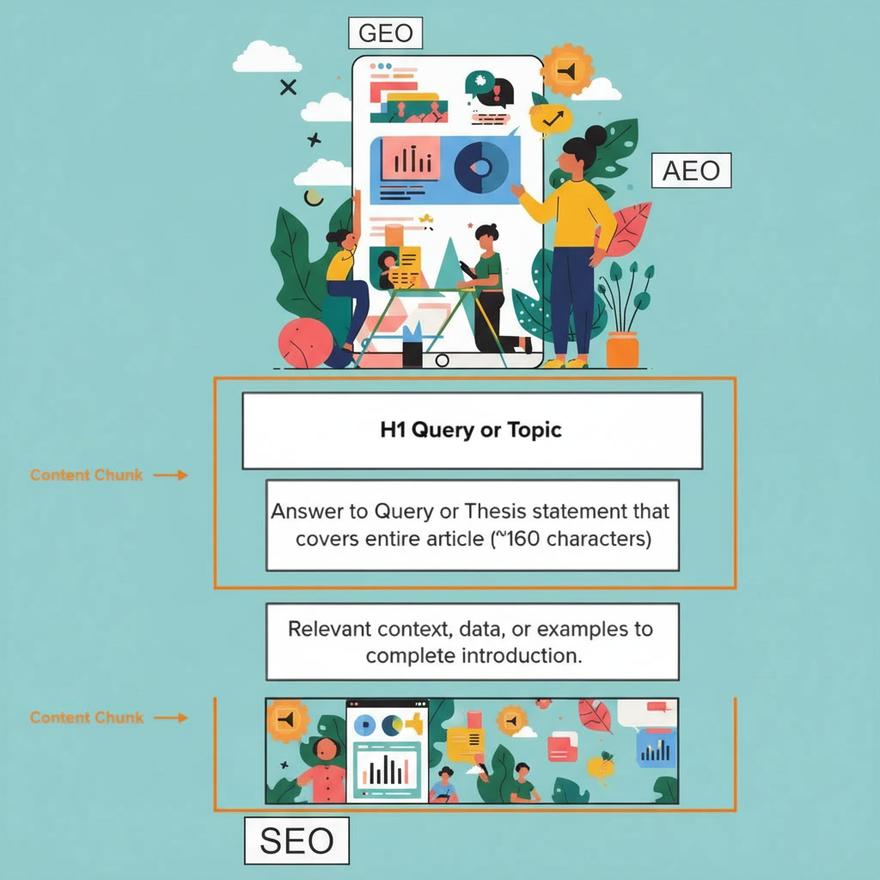
Moving on to the article body itself, we can see in the first two content chunks below that every query H2 is immediately followed by a succinct answer in the first paragraph. Both the query and answer are great candidates to be chosen by LLMs and AI search engines as the “best” query-answer for the topic at hand.
And each is followed by more relevant information that more fully expands the answer to the query. Citing relevant data, research or direct quotations from experts would help bolster the depth of the answer even more. Citing (and then linking to) in-house experts is better than citing and linking to external experts but use what's available to you.

Other Types of Content Chunk Examples
Beyond the basic query/answer or topic/subtopic approach, other popular ways to chunk content that AI search engines and LLMs regularly choose include more structured approaches, such as:
- how-to numbered steps
- bulleted lists
- pros and cons lists
- and tables
Machines and readers can quickly scan and “read” more complex information quickly this way. Tables are very popular with machines and are served up more often than other structured approaches due their efficiency. Research has shown that “providing tabular structures yields a 40.29% average performance gain along with better robustness and token efficiency.” For LLMs, fewer tokens are expended to understand the content in a table. For humans, tables are also a much faster delivery system of concepts than paragraphs of words.

The rest of the article uses a bulleted list approach for each of the remaining subqueries, which gets tedious for human readers and is less efficient for machines. It’s a good idea to think about how to vary the approach. Consider the following transformation of a bulleted list to a much more helpful (and informative) table.
Content Chunk Before:
What are alternatives to a debt consolidation loan?
Depending on your situation, you may want to consider other options.
- A new budget to address debt: Adopting the right budgeting strategy for you may be one alternative. You might consider the debt snowball vs. debt avalanche method or "50-30-20" budget approach.
- Credit card balance transfer: A balance transfer card often offers an introductory low or 0% APR promotion for a set period. However, you may be charged a balance transfer fee, and any debt remaining after the promotional period ends might be subject to the card's regular APR.
- Home equity loan: A home equity loan allows you to borrow by using the amount of equity you have in your home. Loan amounts are typically larger than for a personal loan, and interest rates may be lower.
- Debt management plan: You may consider pursuing a debt management plan through a nonprofit credit counseling agency. It may help you negotiate a lower interest rate and monthly payment.
Content Chunk After:
What are alternatives to a debt consolidation loan?
Depending on your situation, you may want to consider other options.
|
Option |
How it works |
Key considerations |
|
New budget |
Adopt a budgeting strategy such as the debt snowball, debt avalanche, or ‘50-30-20’ approach. |
Low or no cost; requires discipline and consistency. |
|
Balance transfer card |
Move debt to a card with an introductory low or 0% APR for a set period. |
Balance transfer fees may apply; regular APR kicks in after the promotional period ends. |
|
Home equity loan |
Borrow against the equity in your home, often at a lower rate than personal loans. |
Loan amounts can be larger; review the agreement carefully for all terms. |
|
Debt management plan |
Work with a nonprofit credit counseling agency to negotiate lower interest rates and monthly payments. |
Best for those with too much debt to qualify for a consolidation loan. |
Clearly the table is more efficient in how the information is presented for the human readers: it’s easily scannable and gives a more thorough explanation of how to understand which alternatives might relate to their current situation. It’s also easier for the machines to parse, which means it will use fewer tokens to scan and therefore, gives the machine more “reason” to pick this chunk as the best answer for the query at hand.
Adding FAQ Blocks at the End of the Page
Another place to improve the page and boost visibility would be to add an FAQ block to the end of the page. A structured FAQ block that covers all the related queries is standard practice for YMYL sites and one of the most reliable AEO patterns available to publishers.
AI search engines and Google’s AIO are designed to answer discrete questions. An FAQ section maps directly to the query/answer pattern by presenting question and answer pairs that the machines can lift and serve with minimal parsing. Each FAQ item is essentially another highly efficient self-contained content chunk that requires fewer tokens to “find”.
On a YMYL page specifically, an FAQ section can serve double duty, by presenting long-tail conversational queries that don’t fit neatly in the main article’s H2 structure. The “but what if” or “how do I know” or “what about this” questions that readers type into search. Google’s People Also Ask feature surfaces these kinds of queries and having an FAQ that catches everything that falls between the H2 subtopics gives the page an extra boost at being selected for citation.
Structure is the Strategy
The example article covered here gets more right than wrong. The query/answer structure is solid. Every H2 is a question a real user would type, and the answer follows immediately in the first paragraph. The table of contents signals genuine topic authority by mapping the full query fan-out around debt consolidation. And where answers include even more structure via how-to steps, bulleted lists, tables, etc., the content becomes faster to scan for humans and cheaper to parse for machines.
But the omissions found in this article matter more on a YMYL page than they would anywhere else. A missing author is a missing E-E-A-T signal in a category where Google's quality raters are specifically looking for demonstrated expertise. A stand-alone pillar page, no matter how great it is, will be better served with linked cluster pages that shows the full breadth of the brand authority. And adding an FAQ section will expand the possible content chunks that can be retrieved for citations, covering all the possible bases for user queries about debt consolidation. Most fatally, inconsistent information architecture at the URL and breadcrumb level sends mixed signals to machines about the specific context of the page, potentially undermining all the other context-building elements found on the page.
Refreshing old pages to these new authoring standards will position brands to earn citations on AI search engines like Perplexity, in Google AIOs, and in LLM responses across ChatGPT, Claude, and Gemini. A brand I worked with saw a 586% increase in AI search visibility. The content was restructured to be understood, trusted, and reused and the machines noticed. Optimizing for GEO, AEO, and AIO means building pages that answer questions completely, credibly, and in a format that both humans and machines can act on.