Recently I spoke with a recruiter who was managing their agency’s evolution. They had a well-run content marketing operation for their clients, but their content (marketing) strategists focused squarely on the buyer’s journey across the sales funnel and positioning content to targeted audiences. With the rise of AI search and the need to structure data more tightly for the machines, they knew they needed to expand their skillset to include content management strategy: that is, the management of the content itself and how it moves through the tech ecosystem.
This is the work I’ve been doing for over ten years: information architecture, taxonomy, governance, CMS and DAM requirements, and change management for the business users (the people, process, and tech side of websites).
The only thing that has changed in my world is the urgency. Ten years ago, the messaging needed to sell my work was all about getting to automation and personalization at scale. If a company didn’t need (or want) to automate or personalize they could ignore getting their content in order. For those companies, that content debt is being called in.
What Content Debt Looks Like in 2026
Content debt is essentially an accumulation of outdated, inconsistent, or unoptimized content on a website that results from prioritizing speed or costs over maintenance and governance. The problems that result compounds over time, some with more detrimental consequences than others. The need for speed or the cost-cutting considerations of 2020 and 2023 live on. A simple decision to not pay a consultant provided by your new CMS vendor can lead to developers setting it up in a way that frustrates everyone who uses it and leads, after 7 painful years, to buying another CMS because the old one “doesn’t work”.
Most legacy organizations carry more content debt than they realize, and AI has now made it impossible to ignore. Here's what some of this debt looks like across a typical enterprise content operation:
Inaccessible or unindexable content. Content locked behind login walls or in PDFs (or both!) containing genuinely valuable information that has never been broken into structured, reusable components. The knowledge exists in the organization's institutional memory but not in any machine's index. For AI search visibility purposes, it doesn't exist at all.
Orphaned and undated content. Pages sitting in the CMS with no author, no publication date, no update history, and no clear owner. Nobody knows if the information is still accurate. AI quality signals (E-E-A-T in particular) penalize exactly this kind of content, and on YMYL topics it's a liability.
Duplicate and near-duplicate content. The same topic covered multiple times across different sections, teams, or microsites, often with conflicting information, have long been a problem. Search engines have always penalized this. AI search engines are less forgiving. Diluted topical authority means fewer citations, not more.
Missing or broken structured data markup. Pages with no machine-readable signals about what the content is. No taxonomy, no article schema, no author attribution, no publication date. Even when the on-page content is excellent, without structured data the machines have no concrete signals to work with. This is one of the most fixable types of debt on the list and one of the most commonly overlooked.
No content lifecycle management. No retirement dates. No review schedule. No process for flagging outdated content. Pages from 2012 sitting alongside pages from 2025 with no signal to humans or machines about which to trust. The organization keeps publishing without ever retiring and the debt grows every quarter.
The Debt That Blocks the Path to Content Readiness
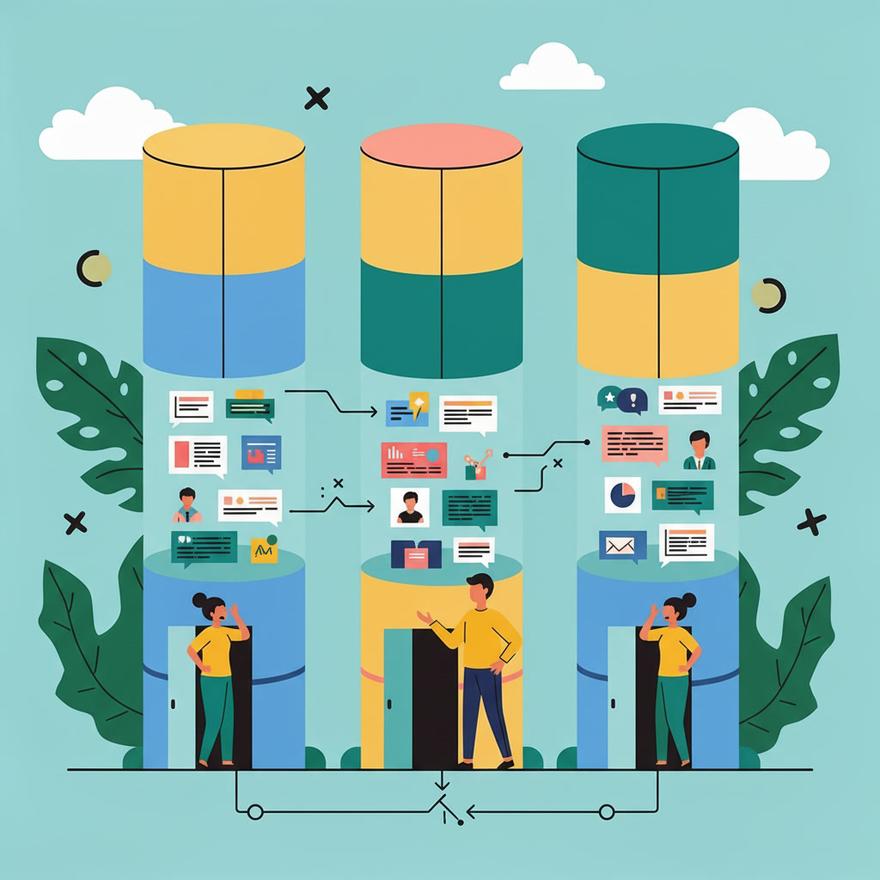
Many legacy organizations have all these issues. Each suggests a discrete project to systematically work through the content and fix it. But by far the biggest problem I've consistently seen with legacy organizations is one that runs very deep and can’t be so easily fixed: the age-old business silo structure that most large enterprises were built on.
I’ve seen websites where the main menu replicates the business structure of the organization exactly, with each business unit “owning” a part of the website. If your content teams operate in different business units with separate budgets, separate tools, and separate ways of working they are likely suffering multiple and intractable pain points that prevent them from working in a cohesive and collaborative way. Until now, for many organizations, the pressure to change to a modern, customer-centric approach simply wasn't strong enough to overcome the inertia. AI has changed that calculation. It requires a unified, structured, consistent content foundation. Siloed operations can't produce that.
The Problem of Siloed Teams and What it Costs
I was once the content expert on a solutions team for a migration and consolidation project, tasked with moving 13 teams onto one CMS. Migrations are usually the trigger for companies to finally implement a taxonomy. Or, like the CMS example above, leadership purchases a shiny new tool, because the one they have “doesn’t work”. Either way, any new platform exists within the company culture and it will inherit the problems of that culture if not acknowledged and mitigated. You don’t want to migrate a mess onto a new tool. That’s a given with content. But what if the mess includes how your teams work?
Moving 13 marketing teams onto one platform is not an easy task. And this was a legacy enterprise with typical legacy issues. The teams operated within business unit silos that followed the org chart instead of the customer journey. Budgets for third-party vendors, tools, file storage, and assets were managed within those silos. Collaboration was wanted and needed, but assets were locked into disparate and disconnected systems, all with their own naming conventions. Personalization was highly desired, but the disconnected tools and lack of a taxonomy prevented it.
I’ve seen silos cause innumerable problems that are not always easy to solve. And for those working within them, it’s often hard to recognize why it’s a problem, because that’s just how it’s always been done. Also, it’s hard to have a holistic view when you’re always heads down on getting content out the door. Heroic efforts to meet every deadline leaves little time to consider a 30,000-foot view. What’s not happening is taking the time to build a holistic content strategy that allows teams to work together towards the broader business goals.
Here are a few more examples of how businesses are impacted when teams are locked in content silos:
Real Costs of Business Silos for Content
|
Content Problem |
Scenario |
Business Impact |
|
Duplication of efforts |
Two teams independently commission the same types of photography and create similar assets, unaware of each other’s work. |
Budget and time spent twice for a single deliverable. Compounded across teams, campaigns, and years. |
|
Brand inconsistency |
Siloed teams develop siloed standards. Print, digital, social, and web each operate independently. Customers encounter different versions of the same brand depending on where they look. |
Erodes brand trust over time. Impossible to enforce standards without a shared system and shared language. |
|
Teams competing against each other, instead of working together |
A product owner wants more real estate on the home page for no strategic reason, or the product side of a website cannibalizes keywords and queries that should be owned by the awareness blog. |
When profits (and promotions) are attributed to business silos, you end up with teams competing against each other at the expense of the customer experience. |
You Can't Fix What You Can't See
The through line I see in all these problems is the lack of a truly holistic view of the marketing operations across all the teams. And because this is the first thing I typically do in discovery for a migration/consolidation project, I developed a Content Maturity Model to show the full scope of content maturity. Moving from left to right, from Level 1 to Level 4 gets you to a state of intelligent content readiness, not just for AI but for your teams and customers as well. I use the model to show what each client’s current state of content is, what the ideal state is, and what a realistic future state looks like at the end of the scoped project.
The Content Maturity Model
|
LEVEL 1 |
LEVEL 2 |
LEVEL 3 |
LEVEL 4 |
|
|
Siloed |
Structured |
Integrated |
Intelligent |
|
|
People |
Siloed |
Ad-hoc, cross-functional campaign teams |
Content team |
Hybrid tech / content team |
|
Process |
Ad-hoc, team driven |
Some centralized planning, basic governance |
Cross-team strategy, reuse by design |
AI-augmented strategy, continuous optimization at scale |
|
Tech |
No CRM, DAM, disconnected tools, local storage |
Underutilized CRM, DAM, CMS, minimal integration |
Integrated CRM, CMS, DAM, PIM with taxonomy |
AI-ready infrastructures, ontology & knowledge graph |
|
Content |
Unstructured, untagged, unfindable, hard to share |
Centralized with basic taxonomy |
Structured, governed, reusable content library of components and fragments |
Ontology-driven knowledge graph, connected intelligence |
|
Channel |
Single channel per team |
Multiple channels, loosely coordinated |
Cross-channel content delivery |
Optimized omnichannel experience |
|
Message |
Single message per team |
Segmented, basic personalization |
Targeted by audience & channel |
Dynamic, 1:1 messaging at scale |
|
|
Content Chaos |
|
Content Readiness |
The model implicitly shows how business silos prevent full maturity. Adding a taxonomy or fixing the discrete content problems mentioned earlier can get you to Level 2 but a dedicated content team and strategy that bridges all the silos is the clear path to Level 4.
Most organizations I work with don't sit neatly in one column of the maturity model. A team might have sophisticated channel and messaging capabilities because the tools they invested in forced some structure, while their content is still untagged, unstructured, and trapped in silos. The model is essentially a map. Knowing where you sit on that map, helps you to plan the route to where you want to go.
I show my clients their current state using a gradient color to fill the areas where they sit for each level and dimension that I saw during discovery, and then I show the future state and the progress that will be achieved by the end of the project. See examples below. It’s a great visual to quickly see the real benefits of the project. It will also show what the logical next steps are to get to Level 4.

Where to Go from Here
Knowing you have a problem is not the same as knowing where to start. The most common question I get from organizations at Level 1 is exactly that: where do we begin? The answer, almost always, starts with tackling the silo problem with the one solution that bridges it better than any platform purchase ever will: a taxonomy. It can solve many content problems quickly while the harder, cultural and structural problems get worked out.
Bridging business silos with taxonomy is the subject of my next post. Follow me on LinkedIn to be notified when I post it.
Not sure where your organization sits on the maturity model? Let's find out together.